
How Honey Is Made: From Flower to Jar
Bees visit two million flowers to make one pound of honey. Here's exactly how the process works and why real honey is always a limited, seasonal product.
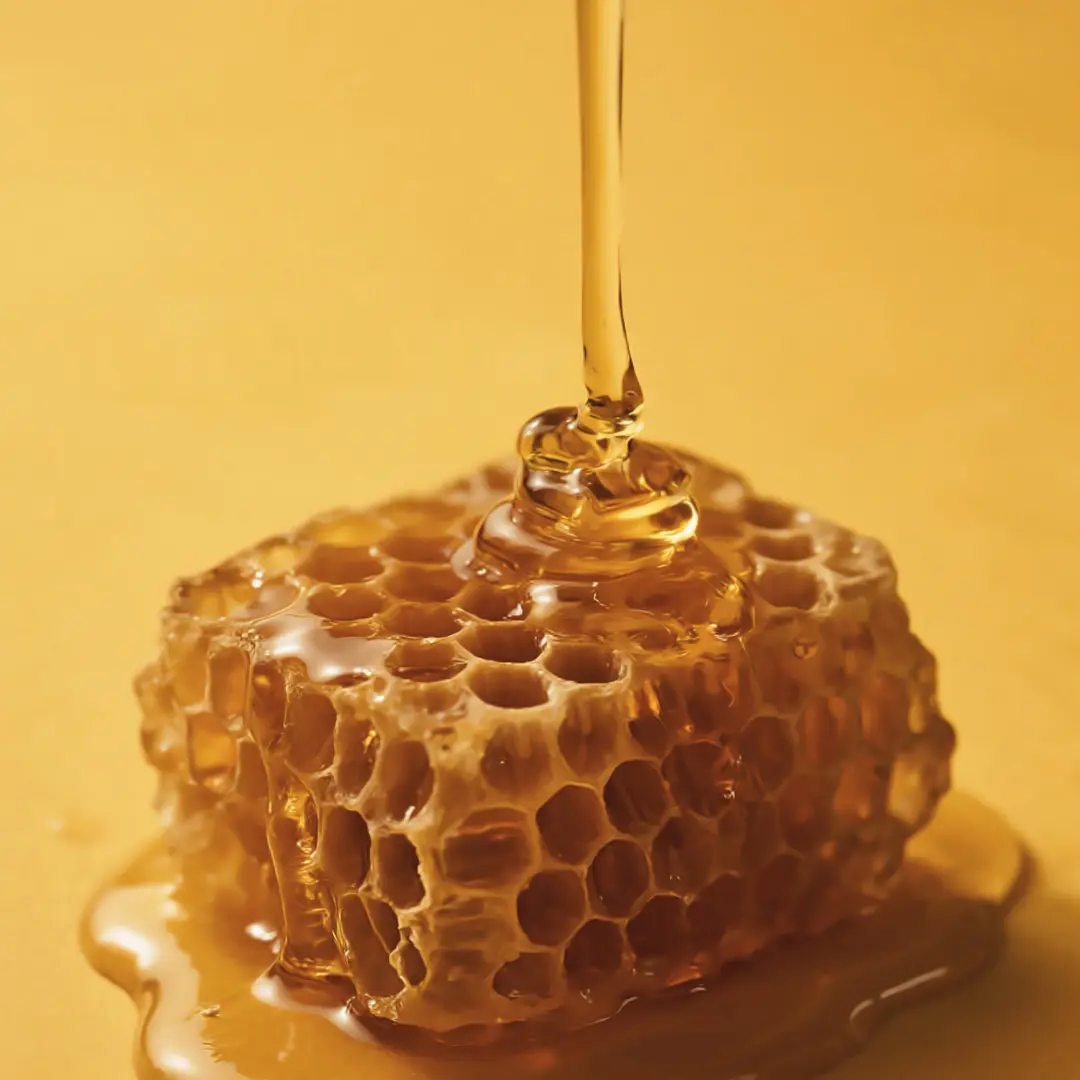
Bees visit roughly two million flowers to produce a single pound of honey. A single worker bee makes about one-twelfth of a teaspoon in her entire lifetime: a lifespan that, during foraging season, lasts about six weeks. An average colony produces 30 to 60 pounds of surplus honey per year, meaning honey beyond what the bees need to feed themselves through the winter. Understanding how honey is made changes the way you think about the product. It stops being a commodity and starts being something closer to a minor miracle of collective labor. Every jar represents millions of flights, billions of wing beats, and a process of chemical transformation that humans have admired for thousands of years but have never managed to replicate.
How bees collect nectar
Honey starts as nectar, the sugary liquid that flowering plants produce to attract pollinators. Nectar is mostly water (roughly 70 to 80%) with dissolved sugars, primarily sucrose, making up the rest. It's thin, watery, and perishable. It's not honey yet.
A forager bee locates a nectar source (a blooming field of clover, a stand of wildflowers, a row of fruit trees) and lands on the flower. She extends her proboscis into the bloom and sucks the nectar into her honey stomach, a specialized organ separate from her digestive stomach. This honey stomach holds about 40 milligrams of nectar, meaning the bee is carrying nearly her own body weight in liquid.
During the flight back to the hive, something important happens. The bee's honey stomach adds an enzyme called invertase to the nectar. Invertase breaks down the sucrose into two simpler sugars: glucose and fructose. This enzymatic conversion is the first step in transforming nectar into honey, and it begins before the bee even gets home.
A forager can visit 50 to 100 flowers on a single trip and makes 10 to 12 trips per day. When she returns to the hive, she passes the nectar to a house bee through mouth-to-mouth transfer, a process called trophallaxis. The house bee chews and processes the nectar further, adding more enzymes and beginning the evaporation process by spreading it across her mouthparts. She then deposits the processed nectar into a wax cell in the comb.
How nectar becomes honey inside the hive
The nectar sitting in those wax cells is still far too wet to be honey. At 70-80% water, it would ferment quickly. The bees need to reduce the moisture content to roughly 17-18%: a concentration at which honey is naturally shelf-stable and resistant to microbial growth. That dehydration is the core of honey production, and the bees accomplish it with remarkable efficiency.
House bees fan their wings over the open cells, creating air currents that accelerate evaporation. The hive itself functions as a dehydrator: the collective body heat of thousands of bees keeps the interior warm (around 93-95°F), and the fanning creates constant airflow. Some bees spread nectar in thin films across the comb surface to increase the exposed area, speeding evaporation further. The whole colony works in concert to dry the nectar down.
This process takes one to three days depending on the humidity, temperature, and how much nectar is coming in. During a heavy nectar flow (when a major bloom is at peak and foragers are bringing in large volumes) the hive can be processing thousands of cells simultaneously, running what amounts to a round-the-clock production line.
Beyond the moisture reduction, the enzymatic activity continues. Glucose oxidase, another enzyme added by the bees, produces small amounts of hydrogen peroxide and gluconic acid. These compounds give honey its antimicrobial properties: the reason honey doesn't spoil and has been used historically as a wound treatment. Together, these enzymes and the low moisture content create a product that is self-preserving.
When the moisture content in a cell drops to the right level, the bees cap it with a thin layer of fresh beeswax. That cap is the bees' quality control stamp. It means the honey inside is fully ripened, chemically stable, and ready for long-term storage. In the wild, this stored honey is what sustains the colony through winter. In a managed hive, it's what the beekeeper harvests.
How a beekeeper decides when to harvest
Not all the honey in a hive belongs to the beekeeper. The colony needs a substantial reserve to survive the winter: typically 60 to 90 pounds in colder climates, less in milder ones. A responsible beekeeper only takes the surplus, leaving the bees enough to sustain themselves without supplemental feeding.
The timing of harvest depends on what's blooming and when the nectar flow ends. In most of the US, the main honey harvest happens in late summer (July through September) after the major bloom period has wound down. Some beekeepers do a spring harvest as well, pulling early-season honey before the bees transition to summer forage. This is how you get different seasonal varietals from the same hives: the spring pull reflects whatever was blooming in April and May, while the late-summer pull reflects July and August flora. A guide to honey varietals and how they differ.
The beekeeper checks frames for readiness by looking at the caps. A frame that's mostly capped (roughly 80% or more of the cells sealed) is ready to harvest. Uncapped cells still contain nectar that hasn't finished ripening, and pulling those frames would produce honey with too much moisture, risking fermentation in the jar.
The actual harvest involves removing the frames from the hive (usually after gently brushing or blowing the bees off) and transporting them to an extraction area. This might be a dedicated honey house on a bee farm, a garage, a kitchen, or a rented commercial extraction facility. The bees are not harmed in the process, though they're understandably not thrilled about having their food supply temporarily relocated.
How honey gets from the comb to the jar
Extraction is where the beekeeper's hands-on work begins. For liquid honey (the most common form sold) the process involves three steps: uncapping, spinning, and straining.
Uncapping means removing the thin beeswax caps from each cell. Beekeepers do this with a heated uncapping knife, a serrated cold knife, or an uncapping fork that scratches the caps off. The caps fall into a tray, and the residual honey drains off them. This "cappings honey" is often the beekeeper's personal favorite, since it's the freshest and least handled honey in the entire harvest.
The uncapped frames go into an extractor: a centrifuge that spins the frames, flinging the honey out of the cells by centrifugal force. Small operations use hand-crank extractors that hold two to four frames at a time. Larger operations use electric radial extractors that can process dozens of frames per load. The honey collects in the bottom of the extractor drum and drains through a valve into a bucket or settling tank.
From there, the honey passes through a coarse strainer that catches wax fragments, bee parts, and other debris. This straining step is where raw honey and commercial honey diverge. A raw honey producer stops here: the honey goes into jars, still containing its natural pollen, propolis particles, and enzymes. A commercial operation continues with pasteurization (heating to 160°F or higher) and fine filtration, producing the clear, uniform product that fills most grocery store shelves. What raw vs processed means and why it matters.
Some beekeepers skip extraction entirely and sell comb honey: sections of capped comb cut directly from the frame. This is the least processed honey product available, since the beekeeper's only involvement is cutting and packaging. More about honeycomb and how to eat it.
Why real honey is always limited and seasonal
Once you understand how honey is made, the economics of production become intuitive. A typical backyard beekeeper with 5 to 10 hives might produce 150 to 600 pounds of surplus honey in a good year. A sideline operation with 30 to 50 hives might produce 1,500 to 3,000 pounds. These are small numbers. For context, the US consumes roughly 689 million pounds of honey annually, and domestic production covers only about 20% of that demand.
The production is also inherently unpredictable. A late frost can kill early blooms and wipe out the spring honey crop. A drought can reduce nectar secretion across entire regions. A wet, cold summer can keep foragers hive-bound for days. Colony losses from varroa mites, disease, or winter kill can eliminate hives entirely. Every beekeeper has had a season where expected production fell by half due to factors completely outside their control.
This is why local beekeepers' honey costs what it costs and why it's not always available when you want it. It's a genuinely limited, seasonal, weather-dependent agricultural product produced by a beekeeper managing living colonies that have their own priorities and their own needs. The process that turns two million flower visits into one pound of honey has no shortcuts, no factory acceleration, and no way to scale beyond what the bees and the land can produce.
That scarcity is what makes a jar of local beekeepers' honey different from a jar on a grocery shelf. The grocery jar was produced to meet a supply chain's demands. The local jar was produced because the bees had a good season and the beekeeper had surplus to share. Knowing how honey is made is the thing that makes you reach for the beekeeper's jar instead. Find local honey producers near you. Or better yet, visit a honey farm and see the process firsthand.