
Raw Honey vs Regular Honey
What raw actually means, why it matters, and how to spot the real thing.
Raw honeycomb is honey in its purest form - still sealed in the wax the bees built. Here's how to eat it, what it costs, and where to find it.
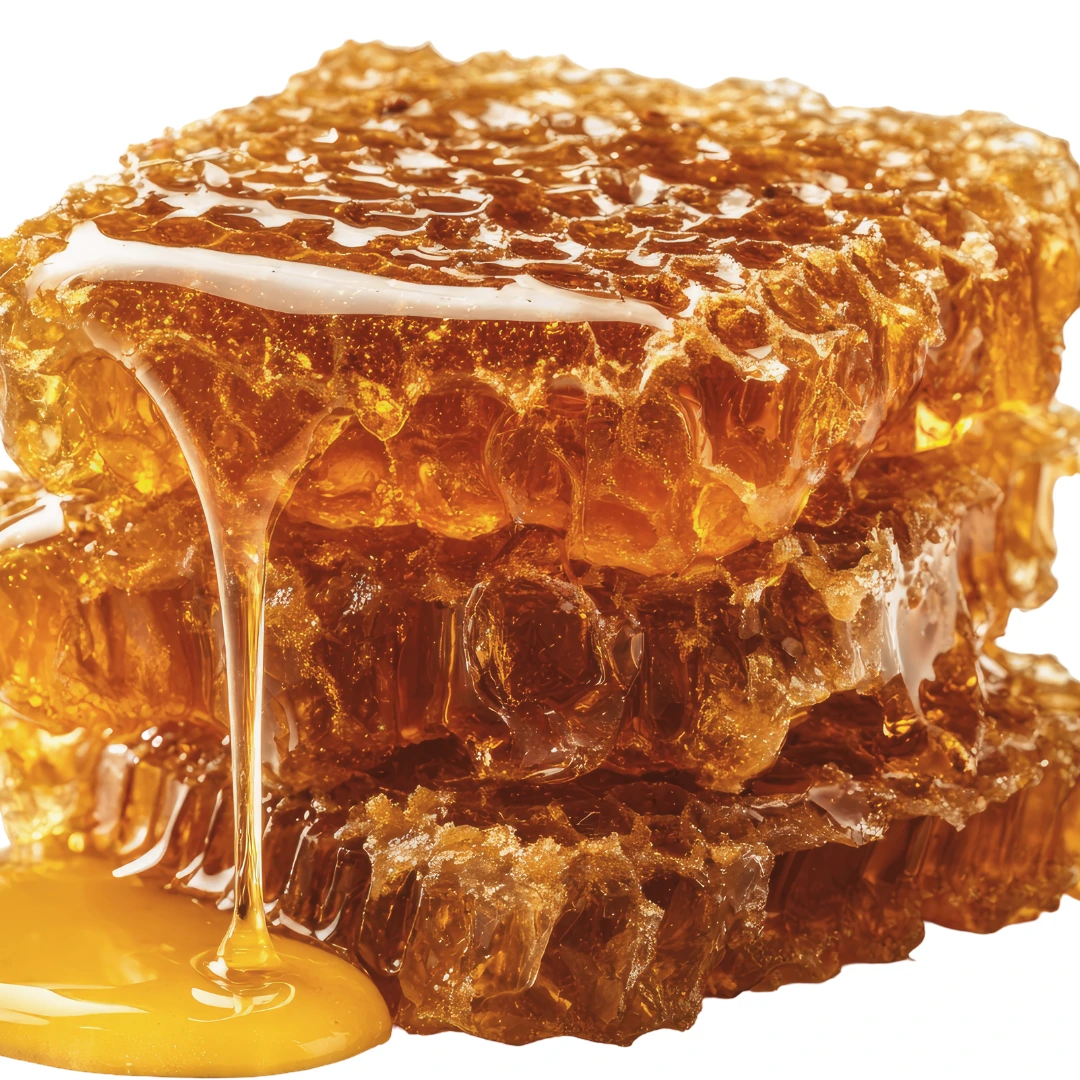
Raw honeycomb is honey that has never left the structure the bees built to hold it. The wax cells are still intact, still capped with the thin layer of beeswax the colony sealed over each cell once the moisture content dropped below 18%. Nothing has been extracted, filtered, heated, or poured. You're eating the honey exactly as it existed inside the hive, wax and all. For a lot of people - beekeepers included - comb honey is the purest, most unprocessed form of honey you can buy. It's also one of the most popular items at any farmers market honey booth, often selling out before the liquid jars do. And if you've never tried it, you're missing one of the more interesting eating experiences the hive has to offer.
Honeycomb is an engineering project. Worker bees produce beeswax from glands on the underside of their abdomens, secreting it as tiny flakes that they chew and mold into the hexagonal cells that make up the comb structure. The hexagon isn't random - it's the most space-efficient shape that tiles a flat surface without gaps, which means bees use the minimum amount of wax to store the maximum amount of honey. They've been building this way for millions of years.
Once the comb is drawn out, forager bees fill the cells with nectar they've collected and partially processed with enzymes during the flight back to the hive. House bees then fan the open cells with their wings to evaporate excess moisture, reducing the water content from around 70-80% in raw nectar to roughly 17-18% in finished honey. When a cell reaches the right moisture level, the bees cap it with a thin layer of fresh wax. That cap is the seal of quality - it means the honey inside is fully ripened and shelf-stable.
When beekeepers harvest comb honey, they're cutting or packaging sections of this capped comb directly, without extracting the honey from the cells. What you buy is exactly what the bees made: wax structure, honey inside, caps on top. The beekeeper's role is basically limited to choosing which frames to cut and how to package the sections.
The most common question people have about honeycomb is whether you actually eat the beeswax. You do. Beeswax is food-safe, non-toxic, and has been consumed by humans for thousands of years. It's made primarily of long-chain fatty acids, esters, and hydrocarbons. It doesn't digest - it passes through your system much like dietary fiber - but it's completely safe to chew and swallow.
The texture is part of the appeal. When you bite into a piece of fresh comb, the wax cells pop and release the honey inside. You get a rush of flavor that's more intense than liquid honey because the honey hasn't been exposed to air or handled in any way. Then you're left chewing a soft plug of beeswax that gradually loses its honey and becomes something like a natural, mildly sweet chewing gum. Some people swallow it, some chew and discard it. Either way is fine.
The wax itself carries trace amounts of propolis (the resinous substance bees use to seal cracks in the hive) and pollen, both of which contribute subtle flavor notes you won't find in extracted honey. Propolis in particular adds a faintly resinous, almost piney quality that some people notice in fresh comb. It's one of the reasons honeycomb tastes slightly different from liquid honey even when they come from the same hive and the same harvest.
The simplest way is to cut a small piece - roughly an inch square - and eat it on its own. Let the honey burst out of the cells as you chew. That's the baseline experience, and it's enough to understand why people seek this product out.
Beyond that, honeycomb works remarkably well as a component on a cheese board. Pair it with a sharp aged cheddar, a creamy blue, or a mild brie - the waxy texture and clean sweetness play off the salt and funk of cheese in a way that liquid honey drizzled on top doesn't quite replicate. The physical contrast matters. There's something about biting into wax and cheese together that's more satisfying than honey poured over cheese.
On warm toast or a fresh biscuit, a chunk of comb honey softens and partially melts, spreading the honey into the bread while the wax goes slightly translucent and chewy. It's messier than liquid honey and worth every bit of the mess. With charcuterie - particularly cured meats like prosciutto or salami - the honeycomb adds sweetness that cuts through fat and salt without becoming cloying.
Honeycomb also shows up increasingly on restaurant menus. Industry data projects honeycomb on menus to grow 57% over the next four years, driven largely by the brunch, charcuterie, and small plates trends. Restaurants use it as a visual centerpiece - a piece of glistening comb on a board communicates quality and craft in a way that a ramekin of liquid honey can't.
One practical note: comb honey is best stored at room temperature. Refrigerating it makes the wax hard and the honey more likely to crystallize. In a sealed container at room temperature, it keeps for months with no loss of quality. Like all honey, it doesn't spoil.
A jar of liquid honey from a local beekeeper might run $10 to $15 per pound. A section of comb honey from the same beekeeper will usually cost $5 to $10 for a piece significantly smaller than a pound. By weight, comb honey is considerably more expensive than extracted honey. There are real reasons for that.
First, producing comb honey requires the bees to build fresh wax. When beekeepers extract liquid honey, they spin the frames in a centrifuge, drain the honey, and return the empty comb to the hive for the bees to refill. The wax gets reused season after season. With comb honey, the wax is the product - it leaves the hive and doesn't come back. The bees have to build new comb from scratch the next time, which costs them energy and time. Bees consume roughly six to eight pounds of honey to produce one pound of beeswax. That's a significant resource cost.
Second, comb honey is more fragile and labor-intensive to harvest and package. Cut comb sections need to be handled carefully to avoid crushing cells and leaking honey. Packaging has to accommodate an irregular, delicate product rather than just pouring liquid into a jar. Many beekeepers sell comb honey in small clear containers where you can see the structure, which adds packaging cost.
Third, demand outpaces supply. Beekeepers who bring comb honey to farmers markets consistently report that it's their fastest-selling product, often gone within the first hour. The same beekeepers typically allocate only a small portion of their harvest to comb because it's less efficient than extracting liquid honey from the same frames. Limited supply plus high demand means the price reflects genuine scarcity, not artificial markup.
Comb honey isn't a grocery store product for the most part. You won't find it next to the plastic bears. It shows up at farmers markets, at farm stands, through small producer websites, and occasionally at specialty food shops or co-ops that carry local products.
Farmers markets are the best bet. Beekeepers who sell comb honey usually display it prominently because it draws people to the booth - a tray of golden honeycomb sections is one of the most visually striking things at any market. If the booth has it, you'll see it. If you don't see it, ask - some beekeepers keep a limited supply behind the table and only bring it out for customers who request it.
Online ordering is another option. Several small producers ship comb honey in protective packaging designed to prevent crushing during transit. The shipping cost adds up, but if there's no local source available, it's a reliable way to get comb honey from a producer in another part of the country. A comb from a Florida tupelo producer will taste nothing like a comb from a Minnesota basswood beekeeper, and trying them side by side is one of the more educational tasting experiences you can have with honey.
If you've been buying liquid honey and haven't tried the comb, it's worth picking up a section the next time you see it. The price per ounce is higher, but you're buying the most unprocessed honey product available - nothing added, nothing removed, nothing heated, nothing filtered. Just bees, wax, and honey, exactly the way it came out of the hive. There's no more honest version of honey than that. Find local honey producers near you.
What raw actually means, why it matters, and how to spot the real thing.
From wildflower to buckwheat to sourwood - what the best American honey varietals actually taste like.
Where to look, what to ask, and why it's worth going beyond the grocery store.